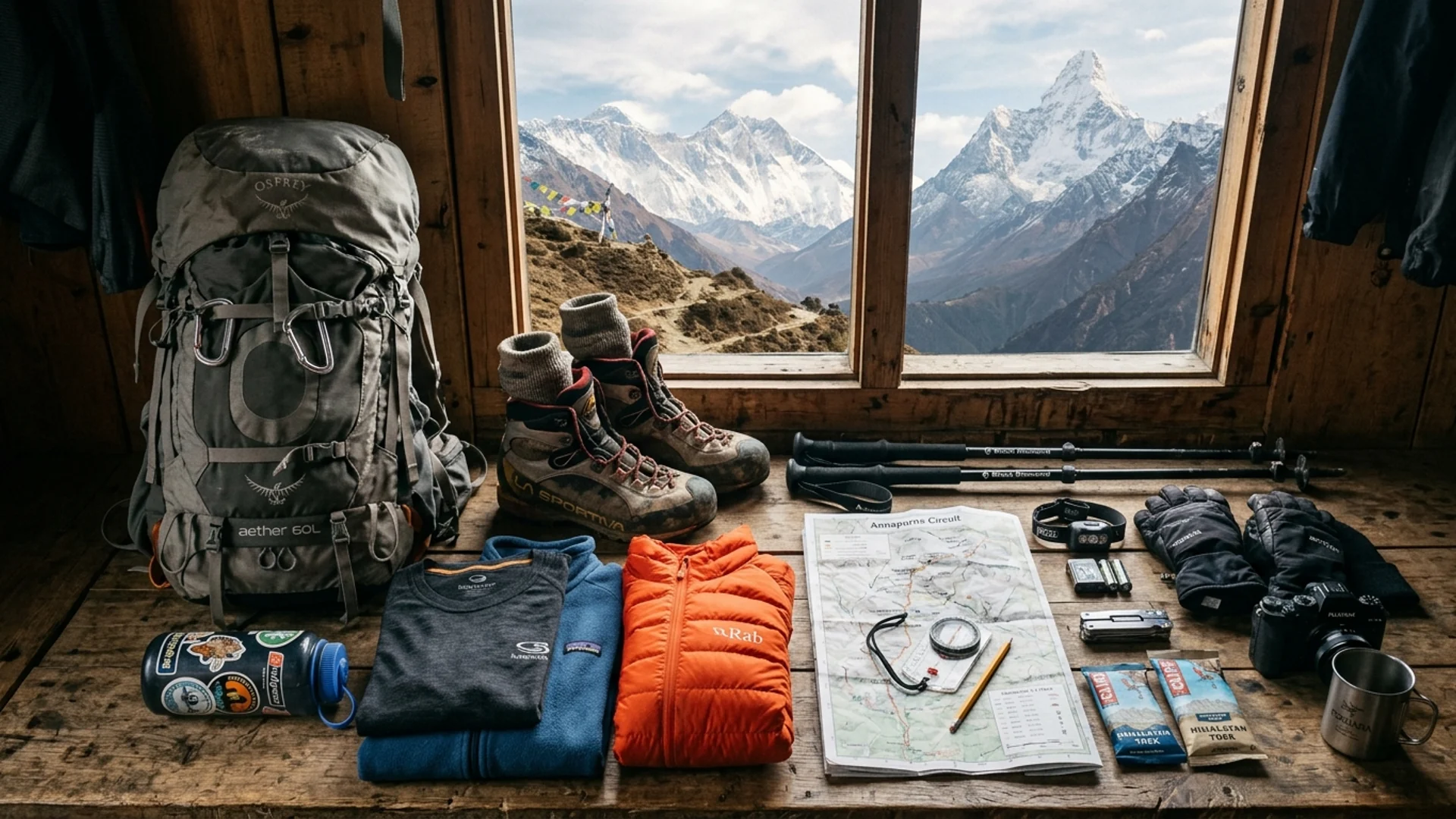
- Follow the 3-Layer System: Moisture-wicking synthetic base layer, insulating fleece & down mid-layer, and waterproof/windproof outer shell.
- Avoid all cotton apparel: Cotton absorbs sweat, takes hours to dry in mountain humidity, and causes rapid hypothermia when cold winds pick up.
- Footwear criteria: Ankle-height trekking shoes with deep lug soles (Vibram or equivalent) and water-resistant membranes; break them in 2 weeks prior.
- Target pack weight: A loaded 50–60L backpack should weigh between 8 kg and 10 kg maximum for safe and balanced ascent posture.
- Essential protection: UV Category 3 or 4 sunglasses are mandatory above 10,000 ft to prevent photokeratitis (snow blindness).
The Science of Mountain Packing
In the high valleys of Uttarakhand, weather conditions can transform from bright sunshine to cold gusts, sleet, or mountain snowfall within forty minutes. Packing for a Himalayan trek is therefore not about carrying heavier garments; it is about assembling a versatile layering system where every item serves a functional purpose.
The Golden Rule: Avoid Packing for "If" Situations
Trekkers frequently overpack by anticipating hypothetical situations: carrying three extra fleeces "if" it turns unusually cold, or duplicate trousers "if" one gets soiled. This habit swells backpack weight past 12–14 kg, overloading knees and hip joints on mountain trails. A disciplined 50–60L pack should weigh between 8 kg and 9.5 kg (excluding water).
The Three-Layer Principle Explained
| Layer | Functional Purpose | Recommended Material | Garment Examples | What to Avoid |
|---|---|---|---|---|
| Base Layer | Pulls sweat away from skin; keeps body dry | Merino wool or high-gauge polyester/polypropylene | Quick-dry synthetic trekking tees, thermal inner tops & bottoms | Cotton t-shirts, cotton banyans (they trap sweat and cause chills) |
| Insulation Layer | Traps body heat within air pockets to keep you warm | Micro-fleece, polar fleece, or high-loft down | 100–200 gsm fleece jacket, 650–750 fill down jacket | Heavy wool sweaters (heavy, slow-drying, non-compressible) |
| Outer Shell | Blocks mountain winds, torrential rain, and snow | Waterproof, breathable membrane (min 10,000 mm hydrostatic head) | Technical hardshell jacket, breathable poncho, rain pants | PVC non-breathable plastic raincoats (cause internal sweat drenching) |
Footwear Engineering: Why Trail Shoes Matter
Mountain trails in Garhwal alternate between hard-packed dirt, wet pine needles, loose river gravel, boulder scree, and hard snow.
- Why Regular Sports Shoes Fail: Running shoes are built for linear forward motion on flat asphalt. They lack lateral ankle support, torsional rigidity, and deep lug traction. On wet boulder moraines or mud slopes, smooth running soles slip easily, straining ankles.
- Trekking Shoe Architecture: Look for shoes with a minimum 4–5 mm deep multidirectional lug pattern (Vibram, Contagrip, or Decathlon CrossContact). High-cut or mid-cut collars stabilize the ankle joint when carrying a loaded pack down steep descents.
- Break-In Protocol: Always break in new trekking boots with at least 15 to 25 km of walking over two weeks before your expedition to mold the footbed and prevent trail blisters.
Complete Apparel Checklist
1. Upper Body
- Trekking T-Shirts (3 Units): Full-sleeve synthetic quick-dry t-shirts. Full sleeves protect your arms against high-altitude UV rays and thorny alpine scrub.
- Thermal Base Layer (1 Pair): 1 set of moisture-wicking thermal top and bottom (worn strictly at campsites and inside sleeping bags). Keep them dry inside a waterproof dry bag.
- Fleece Mid-Layer (1 Unit): Lightweight 200 gsm fleece pullover for hiking on chilly mornings.
- Down / Feather Jacket (1 Unit): Heavy down jacket rated for temperatures down to -10°C. Essential as soon as you stop moving at campsites above 10,000 ft.
- Waterproof Windcheater / Rain Shell (1 Unit): High-grade waterproof jacket with taped seams and an adjustable hood.
2. Lower Body
- Trekking Pants (2 Units): Quick-dry stretchable nylon or polyester trekking trousers. Quick-drying fabric is vital in case of stream crossings or sudden rain.
- Thermal Bottom (1 Unit): For night warmth inside tents.
- Waterproof Rain Trousers / Poncho (1 Unit): Lightweight rain pants to protect against cold wind and downpours.
3. Footwear & Socks
- Trekking Shoes (1 Pair): Sturdy, ankle-support shoes with deep rubber lug patterns. Break them in with at least 15 to 20 km of walking before leaving home to avoid blisters.
- Camp Footwear (1 Pair): Lightweight sandals or slip-on shoes to allow feet to breathe and dry around camp.
- Synthetic Hiking Socks (3 Pairs): Padded, anti-blister sports socks that dry rapidly.
- Warm Woolen Socks (2 Pairs): Pure merino or thick woolen socks kept clean and dry strictly for sleeping warmth.
4. Head, Face & Hand Protection
- Sun Cap / Wide-Brimmed Hat (1 Unit): Protects face, ears, and neck from harsh mountain UV rays during daytime walking.
- Woolen Beanie / Balaclava (1 Unit): Covers ears and forehead for mornings, evenings, and summit pushes.
- Neck Gaiter / Buff (2 Units): Versatile protection against trail dust, wind chill, and sun exposure.
- Fleece Inner Gloves (1 Pair): For nimble tasks and mild morning cold.
- Waterproof / Insulated Outer Gloves (1 Pair): Windproof outer gloves for snowy high passes.
Technical Hardware, Hardware & Accessories
1. Backpack & Daypack
- Main Backpack (50 to 60 Liters): Must have an internal metal stay or sturdy frame, padded ergonomic hip belt to transfer 70% of load to your pelvis, and an integrated rain cover.
- Daypack (15 to 20 Liters): Required only if offloading your main pack with a mule; holds water, medical kit, rain jacket, and camera.
2. Trekking Poles (Pair)
- Carrying two trekking poles reduces impact shock on knee joints by up to 22% during downhill descents and improves balance across boulder fields and snow ridges. Choose aluminum twist-lock or lever-lock poles with carbide tips.
3. Headlamp
- Hands-free illumination is essential for pre-dawn summit pushes and camp navigation. Ensure minimum 150–250 lumens output, with spare lithium batteries (standard alkaline batteries lose power rapidly in sub-zero cold).
4. Eye Protection (UV Sunglasses)
- Category 3 or 4 UV-protected sunglasses with wraparound side shields. At 12,000+ ft, snow surfaces reflect up to 85% of UV radiation, risking photokeratitis (temporary snow blindness) within just 2 hours of unshielded exposure.
5. Hydration & Water Purification
- 2 Reusable Water Bottles (1 Liter each): Wide-mouth Nalgene or insulated steel flasks. Insulated flasks allow you to carry warm water on freezing summit nights.
- Hydration Bladder (Optional): Convenient for continuous sipping, but insulate the tube to prevent water freezing at high camps.
Personal Toiletries & Leave No Trace (LNT) Kit
- 1Biodegradable Sunscreen (SPF 50+, PA+++): High UV radiation burns skin rapidly at altitude. Reapply every 3 hours.
- 2Moisturizing Lip Balm with SPF: Prevents painful lip chapping caused by cold winds.
- 3Biodegradable Soap & Toothpaste: Wash at least 50 meters away from water streams to protect pristine mountain rivers.
- 4Quick-Dry Microfiber Towel: Dries in under an hour even in cold weather.
- 5Personal Waste Bag: Every wrapper, wet wipe, and personal trash item must return to Uttarkashi for proper disposal. Wet wipes must never be buried in cat holes as synthetic fibers do not decompose in alpine soil.
Personal Trail Medical Kit
While our Yeti Adventure guides carry comprehensive medical kits, oxygen cylinders, and pulse oximeters, every trekker should carry personal essentials:
- Pain Relief: Paracetamol / Ibuprofen for muscle aches and mild headaches.
- Blister Care: Moleskin, Compeed patches, micropore tape, and antiseptic cream.
- Digestive Care: ORS (Oral Rehydration Salts) sachets, Norflox-TZ, Loperamide (Imodium), and antacids.
- Motion Sickness: Avomine or Ondansetron for the curvy mountain drive to the basecamp.
- Altitude Acclimatization: Diamox (Acetazolamide) — consult your doctor prior to departure.

Yeti Adventure Mountain Operations Desk
Headquartered at Joshiyara, Uttarkashi along the Bhagirathi River. Led by local mountain pioneers and certified leaders from the Nehru Institute of Mountaineering (NIM), high-altitude first responders, and native Garhwali route guides stationed across Gangotri, Sankri, and Harsil.
Uttarkashi Mountain Operations
Connect directly with local mountain veterans for verified road status, shared Maxx departures, permit guidance, and route advice.
NIM-Certified Mountain Leaders
& Local Garhwali Guides
Daily, 8:00 AM – 8:00 PM IST
Joshiyara, Uttarkashi